

Introduction
Most people who get burned in Dubai property deals don’t lose money because of the wrong area or a bad developer. They lose because the paperwork wasn’t checked. Or they assumed the agent was handling it.
That’s the gap most guides don’t address. It’s not that property documents are hard to get. The problem is that many buyers, especially overseas investors, don’t know which papers matter at which step. They don’t know what red flags look like. They also don’t realize that off-plan and ready homes use different papers. That confusion is expensive.
This guide covers the legal property documents you need, what each one actually does, and where buyers most commonly go wrong. If you want a broader view of the full buying journey first, see our comprehensive guide to buying property in Dubai.
What Actually Protects You in Dubai Property Law
Dubai’s property market runs under Law No. 7 of 2006. This law created the Dubai Land Department (DLD) as the central authority for all ownership records. You don’t own it until the DLD says so. A signed contract, a bank transfer, even a developer receipt doesn’t make you the owner. Only the DLD title deed does. To understand how these rules work in practice, our guide on navigating Dubai’s real estate regulations as a first-time investor walks through each layer.
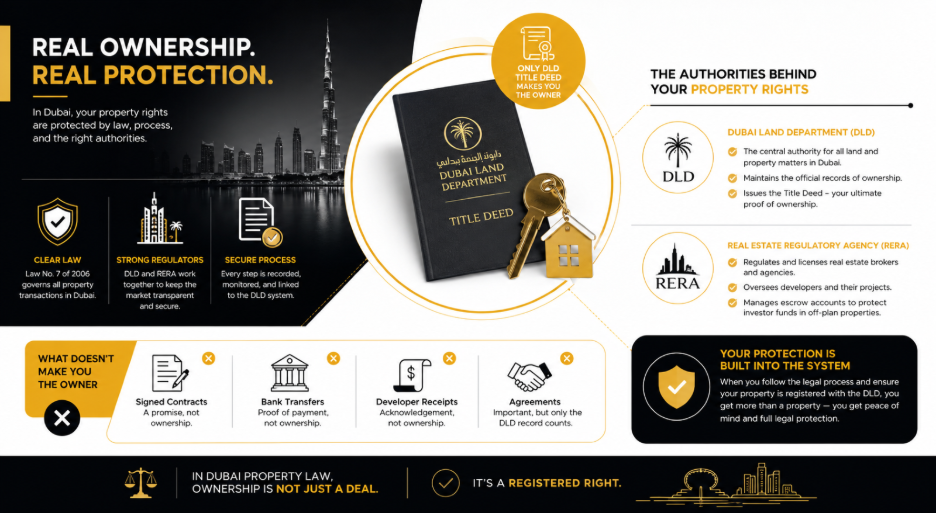
RERA (Real Estate Regulatory Agency) sits under the DLD. It licenses agents, watches developers, and controls escrow accounts on off-plan projects. Both bodies run the legal side of every property deal.
Knowing these upfront matters. No document carries real legal weight unless it connects back to the DLD system.
Why Property Type Changes Everything
The paperwork differs a lot depending on whether you’re buying a ready (completed) property or an off-plan one (still under construction). Many guides mix these together and confuse buyers. They’re not the same process. For a deeper breakdown of each option, read our guide on buying off-plan property in Dubai.
For a ready property, the full ownership transfer happens at a DLD trustee office. You get a title deed on the day of transfer. For off plan, you get an Oqood registration instead. Oqood is your interim proof that you bought into the project. The title deed comes later, when the building is complete.
Mixing these up causes real mistakes. Someone buying off-plan who expects a title deed right away doesn’t understand what they own yet.
The Core Legal Property Documents
Here’s a breakdown of the key documents in a Dubai property deal. Some are your own documents. Others are documents you need to request and verify from the seller or developer.
Your Identity Documents
A valid passport is the one document every buyer must have. It needs at least six months of remaining validity. This applies to residents and non-residents alike. UAE residents also need their Emirates ID. Non-residents don’t need a UAE residence visa to buy in Dubai’s freehold zones.
If you can’t attend in person, you’ll need a notarized Power of Attorney (POA). This lets a representative act on your behalf. The DLD must approve the POA format. POAs drafted abroad often need attestation and sometimes Arabic translation before Dubai authorities accept them. For a full breakdown of the legal process of buying property in Dubai, including how ownership transfer works step by step, see our dedicated guide.
Documents to Request from the Seller
The seller must show you the original title deed. This confirms they own what they’re selling. Don’t just look at the document they hand you. Verify it yourself through the DLD’s own systems.
You also need the No Objection Certificate (NOC) from the developer. This confirms there are no unpaid charges, dues, or violations on the unit. Without a valid NOC, the DLD won’t process the transfer. NOC fees range from AED 500 to AED 5,000 and are paid by the seller.
The Sales Contract
The Memorandum of Understanding (MOU), also called Form F, is the contract both parties sign before the transfer. It covers the agreed price, payment terms, and conditions. At this point the buyer usually pays a 10% deposit into escrow. This document must go through a DLD-registered broker or trustee.
For off-plan homes, you’ll sign a Sales Purchase Agreement (SPA) directly with the developer. The SPA contains full payment schedules, handover conditions, and penalty clauses. Read it carefully.
The SPA is where developers sometimes insert terms that aren’t obvious in a brochure. You can explore the specific projects and payment plans offered by top developers like Emaar Properties, Damac, and Azizi Developments through PFOC’s developer partner pages.
Oqood Registration for Off-Plan Buyers
If you’re buying off-plan, the developer registers your purchase through the Oqood system. This is an interim registration with RERA. It costs AED 430 and protects your rights as a buyer during construction. Think of it as a placeholder title deed. It shows you’re legally recognized as the buyer before the building completes. For a full overview of how Dubai’s off-plan property investment works, including project timelines and escrow protection, see our guide.
Don’t make further payments until you confirm Oqood registration. Payments made before Oqood are not formally protected if a dispute arises.
Payment Proof and Bank Documents
Keep every payment record. Bank transfer receipts, manager’s cheques, and payment schedules all form part of the property purchase documents. These protect you if a dispute arises. They’re also required at the DLD transfer stage.
If you’re using a mortgage, your bank will issue a pre-approval letter before you sign the MOU. This must be shown to the seller and the trustee office. A mortgage registration fee of 0.25% of the loan amount applies, plus AED 290.
How to Do a Dubai Title Deed Check
One of the biggest mistakes buyers make is taking the seller’s PDF at face value. Anyone can edit a scanned title deed. The only real check is through the DLD’s own systems.
You have three ways to do this. The Dubai REST app is the easiest. It’s free and available on iOS and Android. Create an account using your passport details if you’re not a UAE resident. Use the Property Verification section. Enter the title deed number or plot number. The app shows the registered owner, any mortgage against the property, and any legal blocks.
The DLD website at dubailand.gov.ae is the second option. Go to eservices and use the title deed verification tool. You’ll need the title deed number and basic property details.
The third option is a Title Deed Extract from the DLD. This is an official stamped document confirming ownership and any charges or claims. It costs AED 100 to AED 200 and takes one to three working days. For high-value purchases or deals involving a power of attorney, get the extract. Don’t rely only on an app screenshot.
The title deed check reveals undisclosed mortgages, legal disputes, ownership mismatches, and whether a property has been seized. These things happen more than buyers expect.
Documents for Overseas Buyers, Including Pakistani Investors
Pakistani nationals are one of the largest groups of foreign property investors in Dubai. The process is largely the same as for any foreign buyer, with a few extra things to know. For a full investor-focused breakdown, see our guide on property investment in UAE from Pakistan, which covers legal structures, tax implications, and step-by-step guidance for Pakistani buyers.
You don’t need a UAE residence visa. A valid Pakistani passport with six months left on it is enough. You can buy both off-plan and ready homes from within Pakistan. Much of the process can be handled remotely. Attending the DLD transfer in person, or through a POA, is required.
For document attestation, Pakistani buyers need to go through their Union Council or hospital for personal documents first. Then MOFA Pakistan. Then the UAE Embassy in Islamabad or Karachi. Finally, MOFA UAE in Dubai. This takes two to three weeks if done correctly. Budget six to eight weeks if documents have errors or are missing.
Fund transfers must go through official banking channels. The State Bank of Pakistan requires Form M paperwork for large international transfers.
Never use informal transfer methods. Dubai authorities verify where funds come from, especially on large purchases. Our detailed guide on tax and remittance rules for Pakistani buyers covers SBP, FBR compliance, and legal structuring in full.
Ready Property Documents vs Off-Plan Documents
The two processes are different enough to compare directly.
For a ready property, you need the seller’s original title deed, a valid NOC, the signed MOU or Form F, and proof of payment. You’ll also need a clearance certificate for any outstanding service charges or DEWA bills. The DLD transfer happens at a trustee office. The new title deed is issued on the same day.
For an off-plan property, you deal with the developer’s team rather than a private seller. The key documents are the SPA, the Oqood registration certificate, and the developer’s RERA registration number. You also need proof your payments go into a RERA-supervised escrow account. Always ask for escrow account details before paying anything.
Every genuine developer in Dubai must hold buyer funds in a project-specific escrow account. Payments to personal or general company accounts are a red flag. Browse PFOC’s top off-plan property investment opportunities in Dubai to find RERA-registered projects with verified escrow accounts.
Understanding Dubai Property Transfer Costs
Documents are only part of the picture. Knowing the full cost upfront avoids surprises at the transfer stage. For a complete breakdown of what you’ll pay across the buying cycle, our guide on how to calculate true net returns on Dubai property includes all fees alongside ROI modelling.
The DLD transfer fee is 4% of the purchase price. The buyer pays this. There’s also an admin fee of AED 580. The DLD registration fee is AED 2,000 plus 5% VAT for homes under AED 500,000. For homes above AED 500,000, it’s AED 4,000 plus 5% VAT.
Agent commission is usually 2% of the purchase price plus 5% VAT. Developer NOC fees cost the seller AED 500 to AED 5,000. A property lawyer’s fees usually run AED 6,000 to AED 10,000. For a mortgaged purchase, add 0.25% of the loan amount plus AED 290 for the mortgage registration fee. Also check our guide on property taxes in Dubai for international investors to understand what you won’t pay (capital gains, income tax) versus what you will.
In total, budget 7% to 8% on top of the purchase price for all extra costs.
How to Confirm a Developer Is RERA Registered
Before you commit to any off-plan project, check the developer’s RERA status. This takes two minutes. Go to the Dubai REST app or the DLD website. Search for the developer’s name. A listed developer is approved and authorized to sell. You can also browse PFOC’s verified top real estate developers in Dubai to start with a shortlist of RERA-approved builders.
Also check that the project itself is registered with RERA. Every approved off-plan project gets a RERA registration number. Ask the developer or agent for this number. If they can’t provide it, that’s a red flag.
RERA enforcement has grown stricter in recent years. In 2024 alone, the agency fined or warned dozens of brokerage firms and individual brokers for violations. The rules are serious. The fines are real. Working only with RERA-approved parties gives you legal standing if anything goes wrong.
When to Hire a Property Lawyer in Dubai
You don’t always need a lawyer. For a standard off-plan purchase directly from a major developer, the process is fairly clean. The developer’s team handles most of the paperwork.
You should get a UAE property lawyer in a few cases. These include buying through a POA, dealing with an inherited property, buying from a private seller where the title history isn’t clear, or any deal where the contract terms seem unusual. For general guidance on working with agents and advisors in Dubai, see our article on why you should invest in Dubai real estate through a broker or agent.
Legal fees for property review usually run 0.5% to 1% of the property value. A lawyer’s job is to catch what you miss. They flag bad penalty clauses, unclear handover terms, and gaps in the seller’s right to sell.
Who Struggles with the Standard Process
Not every buyer fits the textbook case. Some situations make the process harder.
Buyers with no proof of income, such as entrepreneurs, business owners, or early retirees, can still buy with cash. The process is simpler without a mortgage. You don’t need salary certificates or employment letters. Bank statements showing proof of funds are enough.
Corporate buyers need extra documents. A trade license, board resolution, shareholder documents, and approval letters are all required. The DLD has specific rules for company property ownership
.
Buyers using a POA face more scrutiny. Fake POAs have been used in fraud cases. The DLD checks them carefully. Make sure yours is notarized, attested, and drafted in the exact format required. Get it checked by a UAE-registered lawyer first.
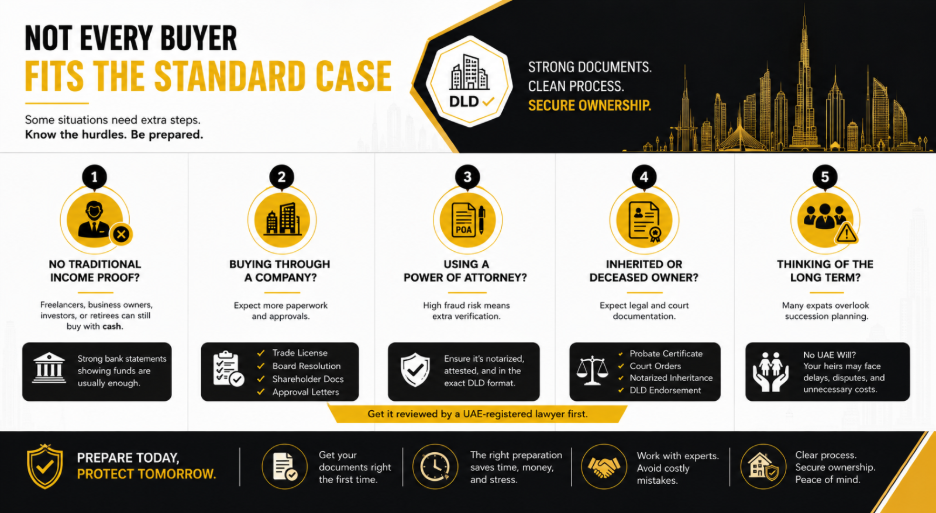
Inherited property or transfers involving a deceased owner require court documents, probate certificates, or notarized inheritance papers. These must be DLD-endorsed. If the owner didn’t register a UAE will, the Dubai courts may need to handle it.
Many expat property owners skip this step and create serious problems for their heirs. For help choosing the right property structure from the start, read our guide on investing in Dubai freehold properties, which explains ownership rights, inheritance protections, and freehold zone rules.
What Can Actually Go Wrong
These aren’t made-up cases. They’re real complaints from buyers.
Double sales on off-plan homes have happened without confirmed Oqood registration. Always confirm Oqood before making further payments.
Undisclosed mortgages are a common issue. A seller’s title deed can look clean while a mortgage still exists in the DLD system. The REST app or DLD website check reveals any registered mortgage. Don’t skip this step.
Altered or forged title deed PDFs do happen in Dubai. The only way to confirm genuine status is through the DLD’s official verification tools.
NOC delays can stall a transfer for weeks. Some developers take time to issue the NOC or demand all service charges first. Build realistic timelines around this.
Fund transfer rejections are a real risk for buyers sending money from Pakistan. State Bank scrutiny on large transfers is strict. Transfers without proper Form M paperwork get held or rejected. Start this process early. For detailed guidance on legally moving money to Dubai, our article on tax and remittance rules for Pakistani buyers in the UAE covers every step of SBP compliance.
Name mismatches are more common than they should be. If the name on your title deed or Oqood doesn’t exactly match your passport, including spelling, the DLD will flag it. Minor errors require a correction through DLD’s title deed correction service before any transfer can happen.
A Note on the Dubai Golden Visa
If you’re buying property worth AED 2 million or more, you may qualify for the UAE Golden Visa. This gives you 10-year renewable residency without needing an employer sponsor. It extends to your spouse, children, and parents.
The property documents covered in this guide, specifically the title deed or Oqood plus the DLD valuation, are the core documents needed in the visa application too. For a full step-by-step guide on how to buy Dubai property for the Golden Visa, including which property types qualify and how to apply, see our dedicated Pakistani investor guide.
Conclusion:
The documents aren’t the scary part. Not knowing what to look for is. When you work with the right team, the paperwork becomes a checklist rather than a risk.
PFOC Properties specializes in guiding overseas investors through the complete Dubai property buying process. Our team works with Pakistani buyers specifically, helping with property selection, paperwork, title verification, and working with developers and the DLD.
If you’re ready to explore off-plan and ready properties in Dubai, or you’d like to speak with an expert about your specific situation, book a consultation with PFOC Properties today.