
New Property Launches in Dubai 2026 – Upcoming Projects & Investment Opportunities

Introduction
Everyone is touting the potential to make money from buying into new developments in Dubai 2026, where the plan is to buy off-plan, hold for two years and then sell with a profit. That’s how everyone pitches their ideas on Instagram and in every message on every real estate agent’s direct messaging platform.
There’s one thing that not many of those posts mention. In the next two years, there will be the handover of more than 100,000 units of property development in Dubai that are being built now. And that’s all happening simultaneously in the next couple of years.
Not every launch deserves your money
Just because a project is new does not mean it will be a good buy. There are many projects that are started in areas that are going to suffer after the initial promotion is over. There are also projects that have payment schemes that seem quite fair until you realize how much money is going to fall due before the handover.
This guide covers what’s actually launching in Dubai in 2026, which areas genuinely make sense, what things cost, who’s allowed to buy, and where deals tend to go wrong. No sales pitch, just the parts you need before you sign.
Why 2026 Feels Different From 2022
Anyone who bought in Dubai back in 2021 or 2022 got in early, when prices were still low and almost anything you touched went up. That window has closed.
By 2026, prices in the strongest areas have already climbed a long way. There’s still money to be made, but the gains are smaller and much more dependent on picking the right project rather than just picking a project. Knight Frank has described this shift as the market moving from rapid expansion into something steadier and more mature.
What “more selective” actually means for you
None of this means the opportunity has disappeared. It means the easy money phase is over, and you now have to do the homework that used to be optional. Location matters more than it did three years ago. So does a developer’s actual delivery history, not just its brand name. So does the price you’re paying relative to what’s really around it.
What’s Actually Launching Right Now
Developers in Dubai have not let their feet rest at all; rather, they are increasing the number of launches as the year 2026 approaches.
The Dubai Hills Estate continues its expansion with the help of newer towers that Emaar has developed. They provide one, two, or three-bedroom apartments that are located in proximity to the golf club and Dubai Hills Park. In general, prices for those houses start higher than AED 1.5 million.
The greener and more experimental side of the pipeline
Expo City Dubai has picked up a batch of new green projects mixing flats and townhouses. It’s built around the old Expo 2020 site, which is now turning into a real hub for business and tourism. Dubai Islands, built by Nakheel, is one of the largest master plans underway right now. Spread across several islands, it should one day include tens of thousands of homes, plus beach clubs and resorts.
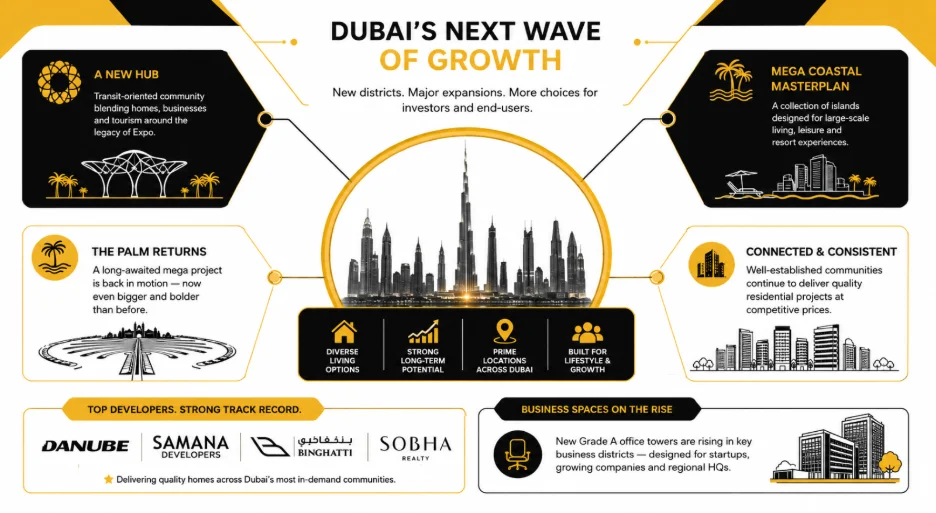
Palm Jebel Ali sat idle for over a decade. Now it’s moving again, and it looks bigger than the first plans called for. Meanwhile, JVC, Business Bay, and Meydan keep turning out steady mid-market launches from names like
Palm Jebel Ali sat idle for over a decade. Now it’s moving again, and it looks bigger than the first plans called for. Meanwhile, JVC, Business Bay, and Meydan keep turning out steady mid-market launches from top Dubai property developers like Danube, Samana, Binghatti, and Sobha, usually at friendlier prices than anything on the water.
There’s office activity too, including a few Grade A towers going up around Business Bay and JVC aimed at startups and regional head offices.
Dubai’s Biggest Master Projects to Watch
Not every launch is a single tower. Some are entire new cities being built inside the existing one, and these play out over years rather than months.
Palm Jebel Ali and Dubai Islands both fall into this group. So does the growth of Al Maktoum International Airport, which should one day handle 260 million flyers a year. That matters to investors because whole new home areas in Dubai South are being planned right around the airport.
Why these projects reward patience over speed
In case you are looking to make money in the long run and not through flipping, then most likely these megaprojects offer the highest return on your investment in the next ten years. However, the downside of the situation is that such infrastructure requires time. In two years, it cannot come to maturity.
Dubai Property Prices in 2026: What You’ll Actually Pay
There are great variations in prices according to different places, but here is an approximate picture of the current state of things.
Small studio and one-bedroom units in JVC and other middle range areas normally cost around AED 700,000 to AED 900,000. In middle range locations like Dubai Hills Estate and Emaar South, one or two bedroom houses typically cost from AED 1.3 million to AED 1.6 million.
Where the real money sits
Waterfront towers in spots like Palm Jumeirah or Dubai Marina cost much more, often AED 2 million and up. Ultra-luxury villas can run into the tens of millions. Off-plan property in Dubai usually sits below a matching finished home, which is the whole appeal. You pay less now for something that won’t exist for another two to four years.
Dubai Property Payment Plans: How the Money Actually Works
Most new launches skip the pay-it-all-upfront model. Instead they spread the price out in stages tied to the build.
One such arrangement would be 10–20% at booking stage and further milestones based on construction progress, followed by one final payment upon delivery or after. Many developers currently provide Dubai off-plan payment plans that work on 60/40 or 70/30 ratios. In other words, a large percentage of the price is only payable after possession.
The catch buried in the fine print
That sounds appealing, and often it genuinely is. But read the actual schedule before you get excited. Some plans front-load tiny payments early and then hit you with a large balloon payment right as handover approaches, and if your cash flow doesn’t line up with that balloon, you can end up scrambling at the worst possible time.
Get the full payment schedule in writing from your agent before you reserve anything. A verbal summary is not the same thing.
Best Dubai Investment Areas for 2026
Not every area performs the same way. This is where many buyers get it wrong. They chase the flashiest render instead of the real rent and resale numbers.
Dubai Marina and JBR stay strong for rental demand, mainly short-term holiday lets. Prices there are already high enough to eat into your return. JVC punches above its weight, offering some of the best rental returns in the city for its entry price. Mostly because it’s central, cheap by comparison, and always in demand from renters.
Where growth and stability actually overlap
Dubai Hills Estate mixes family appeal with steady long-term demand. Emaar backs it, and Emaar tends to finish what it starts. Business Bay works well for both homes and offices given where it sits, between Downtown and the wider business area.
Dubai South and the spots near the new airport are more of a long-term bet, since the payoff hinges on the airport staying roughly on schedule. Rental yields across these areas commonly land between 6 and 10 percent, with some best Dubai neighborhoods for rental yield like JVC studios closer to 8 or 9 percent.
Dubai Property Investment for Pakistanis: What’s Actually Allowed
A lot of confusion sits here, so let’s clear it up directly instead of dancing around it.
Sure, Pakistanis are allowed to purchase property in Dubai. Living in the UAE is not mandatory. Neither does the buyer need a sponsor from that country. All one needs is an authentic Pakistani passport. The downside, however, is that the person can only purchase in freehold areas such as Downtown Dubai, Dubai Marina, JVC, Business Bay, Palm Jumeirah, and many others.
Buying from Pakistan without ever boarding a flight
Pakistanis are one of the biggest groups of foreign buyers in Dubai, right next to Indian buyers. If you’re buying Dubai property from Pakistan and can’t travel, you’ll usually pick someone in Dubai to act for you through a Power of Attorney. A licensed broker can handle most of the paperwork from a distance.
Bank loans are on the table too, though non-residents usually get a smaller loan share, often near 50 percent of the price. Residents can get up to 75 or 80 percent. Because of that gap, a lot of overseas buyers skip a loan entirely and use the developer’s own payment plan instead.
Dubai Property Taxes: The Part People Get Wrong
Ads for Dubai real estate lean hard on “zero tax,” and that’s true under UAE law. But it’s only half the story.
Inside the UAE, there’s truly no yearly property tax, no tax on gains, and no tax on rent you earn. What you will pay are one-time costs at the time of purchase. For the full breakdown of every fee involved, the Dubai property tax guide for international investors covers the 4 percent DLD fee, the trustee office fee, an agency fee near 2 percent, and the developer NOC charge.
Where Pakistani buyers specifically get caught out
Here’s the part that trips people up. Owning property in Dubai doesn’t erase it from your tax picture back home. Pakistan and the UAE share financial data with each other. The FBR now pays closer attention to overseas property owned by Pakistani citizens.
You still need to declare foreign assets under Pakistani law. Zero tax in Dubai does not mean zero tax duty back home. Talk to a tax advisor in Pakistan before you buy, not after the deal is done.
Dubai Off-Plan Projects: The Real Trade-Off
Buying off-plan means you buy a unit before it’s built. You’re working from a brochure and a model unit in a sales office, not a finished building. It’s the main way new properties sell in Dubai right now, and there’s a reason it’s so popular.
The upside is real. You get a lower entry price, flexible payments, and a real chance the unit is worth more once it’s handed over. The downside, which most listings conveniently skip, is that delays are common.
Top-tier developers like Emaar and Sobha run late by roughly three to five months on average, while smaller or newer developers can slip twelve to eighteen months behind schedule, sometimes worse.
Why escrow protection isn’t a perfect safety net
Dubai’s escrow rules are meant to protect you here. Developer money goes into an escrow account and only comes out as construction hits verified stages. If a project falls apart, that escrow money should go back to buyers. In practice, getting your money back can still take a long time if the case has to work through RERA and then the courts. Protected doesn’t always mean fast.
What Can Actually Go Wrong
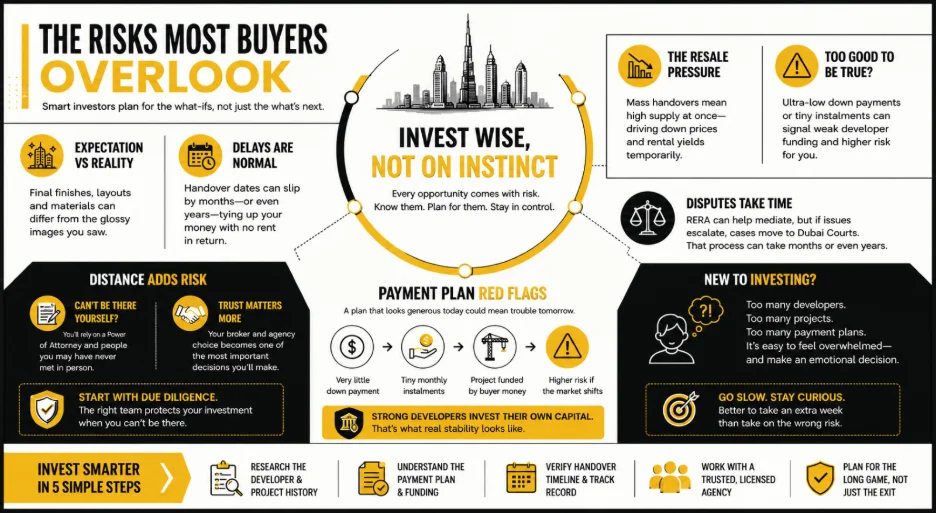
This is the part most articles skip. Here’s what real buyers have run into.
Finished units don’t always match the glossy renders. Finishes get swapped for cheaper ones, layouts shift a bit, and those marketing pictures were never a legal promise of what you’d get. Delays are the most common complaint by far.
A project sold with a 2026 handover date can slip into 2027 or 2028, and your money sits tied up the whole time with no rent coming in.
The resale trap nobody warns you about
Reselling gets harder right around mass handover periods. Dozens of buyers in the same tower often try to sell or rent out units at the same time. That competition pushes both prices and rents down for a while. It’s one of the quieter risks of buying into a big project alongside hundreds of other investors chasing the same exit.
A very generous payment plan can also be a warning sign, not a bargain. A developer asking for very little down and tiny monthly payments may be funding the build straight from buyer deposits rather than its own money.
That’s a very different kind of risk than a big developer with real capital behind it. And when disputes do happen, sorting them out takes real time. RERA can step in and mediate, but if that fails, cases move to Dubai Courts, and that can stretch into years.
None of this means you shouldn’t invest. It means going in with your eyes open and choosing your project carefully instead of on instinct.
Distance and inexperience compound the risk
If you can’t travel to Dubai yourself, you’re leaning on a Power of Attorney and a broker you have to trust completely. That raises the stakes on picking the right agency from day one rather than the first one that reaches out.
And if you are new to real estate investments altogether, the sheer number of developers, properties, and methods of payment can be incredibly daunting. You may easily get swayed by a property that spends the most on advertising rather than the property that is fundamentally sound. None of this rules you out. It just means you need a slower, more deliberate process than someone buying their fifth Dubai property in cash.
A Simple Checklist Before You Commit
Before putting down a deposit on any new launch, run through this list first.
Check the developer’s track record on past projects, not just the one they’re pitching you now. Confirm the project is properly registered with RERA and the Dubai Land Department. Get the full payment schedule in writing, including the exact size and timing of the big payment tied to handover.
Ask what happens if handover gets delayed, then read that clause in the contract yourself instead of taking someone’s word for it.
Two more things worth ten minutes of your time
Check whether the area is facing a wave of similar handovers around the same time as your unit, since that’s the scenario that quietly tanks resale prices. And add up the total cost rather than just the sticker price: the 4 percent DLD fee, the agency commission, and any NOC charges all add up fast.
Talk to a tax advisor back home before you transfer a single dirham. None of this is complicated, but skipping even one step is exactly how people end up disappointed two years down the line.
Conclusion
New properties in Dubai 2026 aren’t a sure win, and they aren’t a trap either. They’re a real chance that rewards people who check the details instead of buying off a glossy brochure and a good sales pitch.
Maybe you’re weighing a few different developers right now. A bit of local help goes a long way. Someone who knows current launches and real payment plans can point you toward what fits your budget.
That’s the kind of help PFOC Properties gives Pakistani and international buyers, from picking the right project to handling the paperwork start to finish. Book a consultation with PFOC Properties to get started.
Frequently Asked Questions
Can Pakistanis buy property in Dubai without visiting?
Yes. A licensed broker and a Power of Attorney can handle most of it for you. Some buyers still like to fly in for the final signing.
Is off-plan or ready property better for a first investment?
Off-plan costs less upfront and offers flexible payments. Ready property gives you rent right away and no delay risk. Which one fits depends on your timeline and how much uncertainty you can handle.
What is the minimum investment for a UAE Golden Visa through property?
You need AED 2 million in property value. That’s the current bar for the 10-year Golden Visa route.
Do I need a UAE bank account to buy property in Dubai?
No, you don’t. This is especially true if you’re using a developer’s payment plan rather than a mortgage.
Are new Dubai properties a safe investment in 2026?
They can be. But it comes down to the developer, the area, and how much homework you put in. The rules are solid. Risk on any single project still swings a lot.