
Freehold vs Leasehold Dubai Property: Which Gives Better Returns for Investors in 2026?

Buying property overseas is a huge step. You are investing real money into a market you cannot visit daily. In Dubai, one initial decision determines everything that comes after: freehold or leasehold.
If you get it wrong, your rental income, resale value, and exit plan will be compromised later. If you get it right, you will create wealth that continues to grow year after year.
This guide compares freehold vs leasehold ownership. It uses current rules from the Dubai Land Department (DLD) and RERA. You will see real rental yields and honest ROI numbers. You will also see the best areas for 2026. Pakistani investors get their own section on rules and remote buying.
Freehold vs Leasehold Dubai Property: Quick Comparison
Freehold gives you full title to the unit and the land. Leasehold gives you the right to use a property for a fixed term. This is often up to 99 years. The land stays with the original owner. Here is how the two compare.
| Factor | Freehold | Leasehold |
|---|---|---|
| Ownership Rights | Full ownership of the property and land. | Right to use the property for a fixed lease term. |
| Land Ownership | Owned by the buyer. | Retained by the freeholder. |
| Ownership Duration | Permanent with no expiry. | Typically 30–99 years. |
| Eligible Buyers | UAE nationals and foreign buyers in designated freehold areas. | UAE nationals and foreign buyers in approved leasehold areas. |
| Rental Income | Strong rental demand, especially in prime locations. | Often offers higher rental yields due to lower purchase prices. |
| Capital Appreciation | Generally stronger long-term value growth. | Slower appreciation as the lease term shortens. |
| Resale Potential | Easier to sell with a broader buyer market. | More difficult as the remaining lease decreases. |
| Inheritance | Can be passed to heirs without restriction. | May require landlord approval or follow lease conditions. |
| Mortgage Eligibility | Widely available from UAE banks. | Limited financing, especially if less than 30 years remain. |
| Service Charges | Standard RERA-regulated charges. | Standard RERA-regulated charges. |
| Best Suited For | Long-term investors, end users, and wealth preservation. | Yield-focused, short- to medium-term investors. |
What Is Freehold vs Leasehold?
Both terms describe two things. How long you control a property. And whether you own the land under it. The difference sounds small on paper. In real life, it changes your financing, your resale plans, and your total return.
What Is Freehold Property in Dubai?
Freehold property Dubai means you own the unit and the land outright, forever. There is no expiry date and no landlord above you. You can sell it, rent it out, leave it to your children, or renovate it freely.
Dubai opened freehold ownership to foreigners in 2002. The approved zones have grown steadily since. Your ownership registers with the Dubai Land Department. You get a title deed in your own name. For a full breakdown of the advantages this gives you, our guide on the perks of investing in Dubai freehold properties covers the key benefits in detail.
What Is Leasehold Property in Dubai?
A leasehold property in Dubai grants you a lease of a property for a certain duration of time. Usually, this is 30 or 99 years. The owners of the land, often the developer, remain the same.
You have the right to stay there and to let the property. You even get sometimes the chance to sell the remaining term. However, major alterations normally require obtaining a written consent. At the end of the lease, the rights revert to the landlord unless the lease is renewed.
Leasehold Land vs Freehold Land
Leasehold land vs freehold land comes down to one question. Who owns the ground your building sits on? With freehold, you do. With leasehold, someone else does. You are renting long term access to it.
Banks look at remaining lease years before they approve a mortgage. Buyers get cautious once a lease drops below 20 or 30 years left. This is called lease decay.
Freehold Property vs Leasehold: Key Differences
Here is the freehold property vs leasehold comparison in plain terms:
- Freehold has no expiry. Leasehold has a countdown clock.
- Freehold owners control renovations. Leasehold owners often need approval.
- Freehold resells more easily. Leasehold resale value often drops as the remaining term shortens.
- Freehold may support Golden Visa eligibility above certain property value thresholds. Leasehold typically does not.
- Freehold suits long-term ownership of 10+ years. Leasehold can suit investment horizons of 5–10 years.
How Dubai Property Ownership Works for Foreign Investors
Dubai lets non-UAE nationals buy freehold property in set areas. This falls under Law No. 7 of 2006. Outside those areas, foreigners are usually limited to leasehold rights, up to 99 years.
Can Foreigners Buy Freehold Property?
Yes. Non-UAE nationals can buy and fully own freehold property in approved areas. No local sponsor is needed. Outside those zones, like parts of Deira and Bur Dubai, foreign buyers are usually limited to leasehold.
Can Pakistanis Buy Property in Dubai?
Yes. Dubai property for Pakistanis works the same as for any other nationality in freehold areas. You do not need UAE residency to buy. You just need a valid passport and proof of funds. Keep your bank documents ready if you need a mortgage. Our guide on property investment in UAE from Pakistan covers the legal structure, SBP remittance rules, and FBR requirements you need to understand before you transfer funds.
Freehold Areas Dubai
Freehold areas Dubai now covers more than 50 zones. The list keeps growing as new communities launch. Popular picks include Downtown Dubai, Dubai Marina, Business Bay, JVC, Dubai Hills Estate, and Palm Jumeirah. Always confirm the status through the Dubai REST app first.
Are Leasehold Properties Available to Foreign Buyers?
Yes. Leasehold is common in older areas, including Deira and Bur Dubai. It also appears in pockets like Green Community and parts of Dubai Silicon Oasis. These often have lower entry prices and strong short-term yields.
Freehold vs Leasehold Dubai: Which Gives Better Returns?
Freehold usually wins on long term growth and resale value. Leasehold can win on short term rental yield, since the entry price is lower. The right answer depends on how long you plan to hold.
Rental Yield Comparison
Dubai’s citywide average gross yield sits around 6.5 to 7.5 percent. Some leasehold pockets, like parts of Dubai Silicon Oasis, have posted 8 to 9 percent. That is because entry prices are lower there. Freehold favourites like JVC also reach 7 to 9 percent. High yield is not only a leasehold trait.
Capital Appreciation Comparison
Freehold tends to pull ahead here. Areas with strong infrastructure, like Dubai Marina and Dubai Hills Estate, show steady growth over many years. Leasehold value can flatten as the remaining term gets shorter.
Resale Value Comparison
Freehold draws a wider buyer pool. This includes cash buyers, mortgage buyers, and Golden Visa buyers. So, resale moves faster. Leasehold resale slows as years run down. Banks also tighten lending on short remaining terms. If you plan to exit at scale, our guide on Dubai property exit strategy for $5M+ properties walks through exactly how to structure and time a high-value sale without losing liquidity.
Long-Term Wealth Creation
For 10 years plus holds, freehold is the stronger base. There is no expiry eating into its value. Leasehold still helps as a lower cost entry point. It frees up capital for a second purchase.
ROI Comparison Example
Numbers help more than theory. Below is a simple, realistic example. It compares a freehold and a leasehold purchase at similar price points. Real figures will vary by property, location, and market timing.
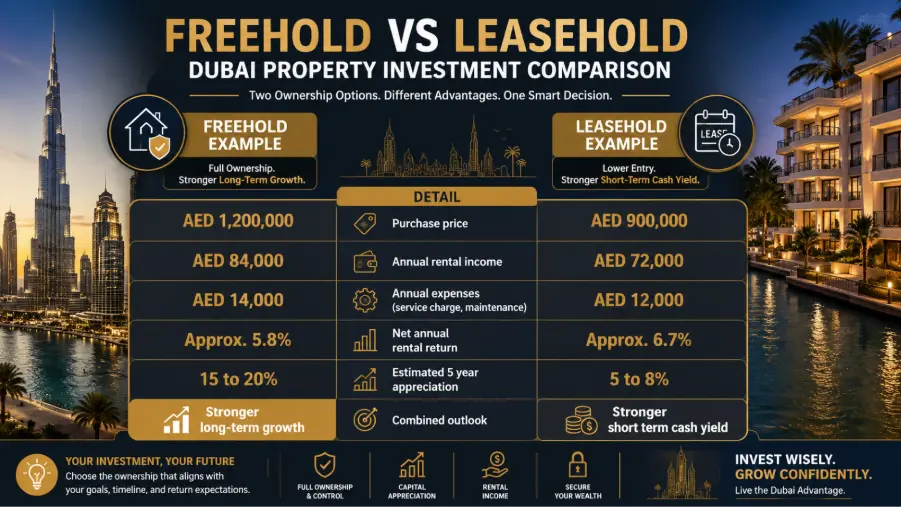
These figures are illustrative. Real Dubai property Roi depends on location, developer quality, market cycle, and how well the unit is managed.
Freehold Property Benefits
Freehold property benefits shape your flexibility, financing, and legacy planning.
- Full ownership of the unit and land, with no expiry date.
- Steady appreciation in established and emerging freehold zones.
- Freedom to renovate, sublet, or hold without third-party approval.
- Wider mortgage access from UAE banks, including for non-residents.
- Easier resale thanks to a larger buyer pool.
- Clear estate planning, as heirs inherit the property directly.
- Golden Visa eligibility for properties valued at AED 2 million or above.
Leasehold Property Risks
Leasehold property risks deserve real weight before you sign.
- Lease expiry means your rights eventually end unless the lease is renewed.
- Structural changes often require the freeholder’s written consent.
- Resale value typically declines as the remaining lease term shortens.
- Financing becomes more difficult once fewer than 20–30 years remain on the lease.
- Lease renewal terms are not guaranteed.
- Long-term value growth is usually slower than freehold
Costs of Buying Property in Dubai
Budgeting only for the purchase price is a common early mistake.
- DLD fee: Typically, 4% of the purchase price.
- Registration fee: A smaller charge for title deed issuance.
- Trustee fee: Paid to the registration trustee office.
- Broker commission: Usually around 2% of the sale price.
- Service charges: Annual maintenance fees calculated per square foot.
- Maintenance costs: Ongoing expenses for maintaining the property.
- Other costs: Mortgage arrangement fees, valuation fees, and insurance.
Dubai Property Taxes Explained
Dubai property taxes are lighter than in most global markets.
There is no annual property tax. There is no capital gains tax on individual sales. Rental income is also not taxed for individuals in the UAE. VAT usually does not apply to home sales.
Pakistani investors should note one thing. Your personal tax duty depends on your own situation and Pakistani law. Get professional tax advice before you finalise any purchase. Our complete guide to property taxes in Dubai for international investors covers every cost from DLD transfer fees to service charges in one place.
Best Freehold Areas Dubai for Investment
Different areas suit different investor profiles.
| Area | Rental Demand | Capital Growth | Best For |
|---|---|---|---|
| Dubai Marina | High, yields 5.5%–7% | Steady | Lifestyle and income-focused buyers |
| Downtown Dubai | High, premium tenants | Resilient, slower growth | Prestige and capital preservation |
| Business Bay | Growing steadily | Strong, driven by canal-front demand | Balanced income and capital growth |
| JVC (Jumeirah Village Circle) | Very high, yields 7%–9% | Strong for its price point | First-time and yield-focused investors |
| Dubai Hills Estate | Strong family rental demand | Steady in a master-planned community | Long-term appreciation seekers |
| Palm Jumeirah | Moderate, yields 4%–6% | Strong trophy-asset premium | High-net-worth investors focused on capital growth |
Dubai Property Buying Process for Overseas Investors
The Dubai property buying process is clear and mostly digital. That makes it manageable even from abroad.
- Define your budget and goal, whether income, growth, or both.
- Shortlist freehold or leasehold options based on your timeline.
- Verify the property status through the Dubai REST app.
- Engage a RERA registered broker for due diligence.
- Sign the Sale and Purchase Agreement or Memorandum of Understanding.
- Pay the deposit, typically 10 percent, and arrange a mortgage if needed.
- Settle DLD fees, registration fees, and broker commission.
- Complete transfer at the DLD or trustee office and receive your title deed.
- Set up property management if buying for rental income.
For a full walkthrough of the legal steps involved, our guide to the legal process of buying property in Dubai covers every stage from MOU to title deed transfer.
How Pakistani Investors Can Buy Property in Dubai
Dubai property investment Pakistan interest has grown steadily. The process needs no UAE residency. Returns often beat local options too.
- Eligibility: Any Pakistani national of legal age can buy freehold property in designated zones.
- Documents: A valid passport copy, proof of funds, and sometimes a bank reference.
- Payment process: Bank transfers or developer escrow accounts, protected under RERA rules for off-plan buyers.
- Buying remotely: Many complete purchases through power of attorney or video verified meetings, without visiting Dubai.
- Mortgage options: Several UAE banks lend to non-resident Pakistani buyers, at lower loan to value ratios.
- Common mistakes: Skipping independent freehold verification and underestimating total transaction costs.
Common Mistakes Investors Make
- Confusing a leasehold property with a freehold one because the area name sounds premium.
- Ignoring service charges when calculating your expected net yield.
- Buying off plan without checking the developer’s delivery track record.
- Skipping a RERA-registered broker to save on commission.
- Underestimating how lease term depreciation affects resale value as it approaches the 20-year mark.
- Assuming Dubai property income is tax-free without considering your home country’s tax obligations.
- Not confirming Golden Visa eligibility before assuming your property qualifies.
Which Option Is Right for You?
There is no universally better choice. It depends on your timeline, budget, and priorities.
Freehold is better if: You plan to hold for 10 years or longer. – You want the strongest resale liquidity and appreciation potential. – You are targeting Golden Visa eligibility. – You want to pass the property to heirs without restriction.
Leasehold may be better if: – Your budget is limited and you want a lower entry price. – You are focused on short to mid-term rental yield. – You plan to exit within 5 to 10 years. – You are testing the market before a larger freehold purchase.
Final Verdict: Freehold vs Leasehold Dubai Property
Are you building long term wealth? Do you want Golden Visa eligibility? Then freehold is the stronger choice. It costs more upfront. But it removes the countdown clock that affects every leasehold asset over time.
Is your budget tighter, or your horizon shorter? Leasehold can be a smart, lower risk entry point.
Long-term investors should lean freehold. So should those planning to pass property to family. Rental income investors with a five-to-ten-year horizon can do well with either option. Just verify the yield numbers property by property.
First-time overseas buyers often start smaller. Many Pakistani investors choose a mid-priced freehold unit in JVC or Business Bay. This balances affordability with freehold’s long-term advantages.
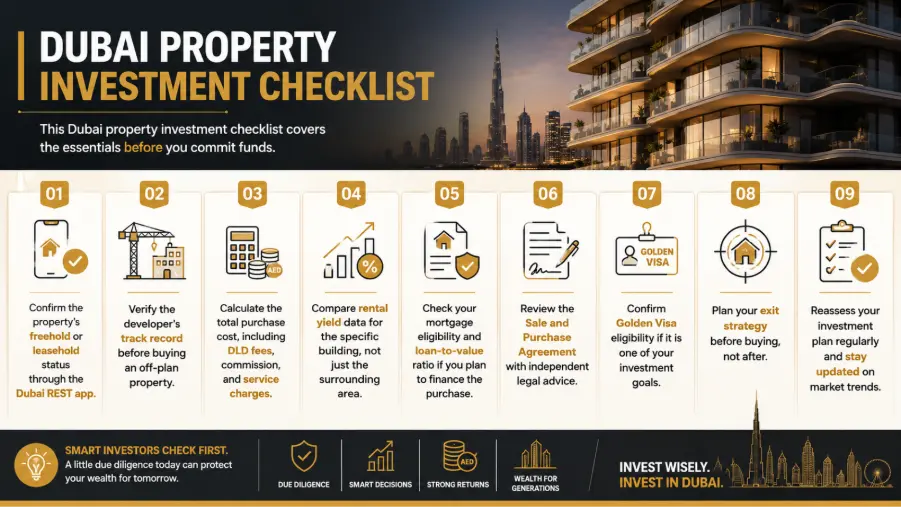
Whatever path fits your goals, take three steps first. Verify ownership status yourself. Budget for the full transaction cost. Work with a RERA registered professional before you sign. That one habit prevents most costly mistakes. Talk to the PFOC Properties team to get a clear picture of which option fits your goals before you commit to anything.
Frequently Asked Questions
1. Can Pakistanis buy property in Dubai?
Yes. Pakistani nationals can buy property in Dubai’s designated freehold areas without UAE residency. Buyers must meet the developer’s or seller’s requirements and complete the standard purchase process through the Dubai Land Department.
2. Do I need UAE residency to buy property?
No. Foreign nationals can buy freehold property in approved areas without being UAE residents. Residency is not required to own property, although it may be relevant for certain visa programs.
3. Which ownership type gives higher ROI?
It depends on your investment goals. Freehold properties generally deliver stronger long-term returns through capital appreciation and easier resale, while leasehold properties may offer attractive rental yields at a lower entry cost in some locations.
4. What hidden costs should investors expect?
In addition to the purchase price, buyers should budget for DLD fees, registration and trustee fees, broker commission, annual service charges, mortgage-related costs (if applicable), and ongoing maintenance expenses.
5. Can I get a mortgage as a non-resident?
Yes. Many UAE banks offer mortgages to non-resident buyers, although loan-to-value ratios, down payment requirements, and eligibility criteria are typically more restrictive than for UAE residents.
6. What is the minimum value for a Golden Visa?
A property investment of at least AED 2 million in qualifying real estate is generally required to be considered for the UAE Golden Visa. Applicants should verify the latest eligibility criteria before making a purchase.