
Dubai Property Exit Strategy: How to Buy and Exit $5M+ Dubai Properties Without Losing Value

Introduction
You bought a Palm villa three years ago for 8 million. Today, a 10.5 million valuation makes you feel like a winner. But when you actually list it, reality hits. You are competing with 47 other owners in your neighborhood. Your agent wants a commission. The buyer demands a 5% discount because the market is rotating.
Suddenly, 800,000 of your profit disappears before the deal even closes. This is the reality of Dubai property in 2026. Entering the market was an easy part. Selling is where people lose their gains because they didn’t plan for the exit.
Why Your Exit Strategy Should Start Before You Sign the SPA
Here’s something nobody told me when I bought my first Dubai property: the best time to plan your exit is before you make an offer.
Most investors are obsessed with finding the perfect unit at the perfect price. They’ll negotiate AED 50,000 off the purchase. Then they’ll lose AED 300,000 on the exit because they never thought about how they’d actually get out.
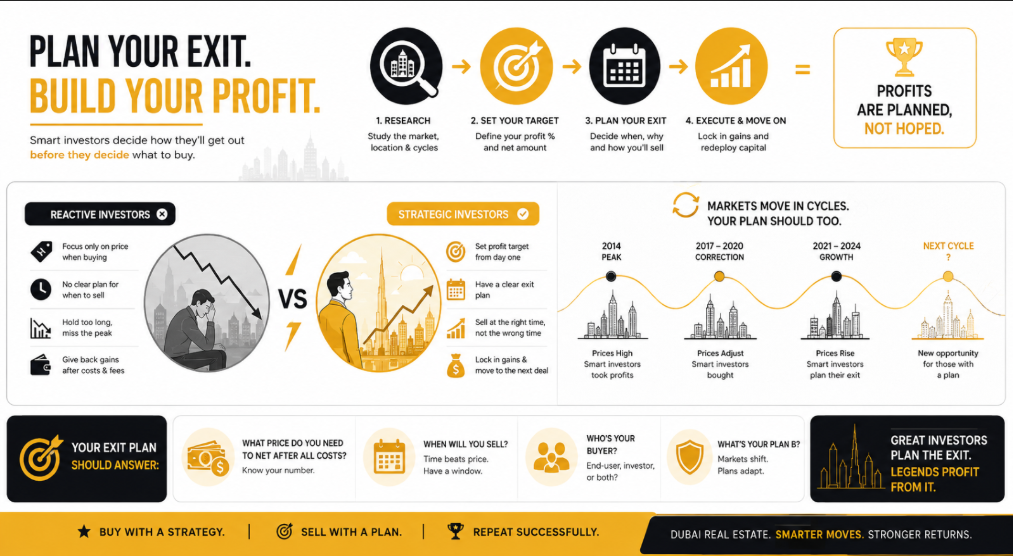
Are the investors making real money in Dubai? They set their profit target on day one. If they bought an off-plan property in 2022 targeting a 25% gain, they’re selling now. They’re not waiting to see if it hits 30% or 35%. They locked in the win and moved on.
Because here’s the thing about the Dubai real estate market. It moves in cycles. Always has. The people who sold near the 2014 peak and bought during the 2017 to 2020 correction? They doubled their money. The ones who held without a plan? Some of them are still underwater.
Your exit strategy isn’t about abandoning Dubai. It’s about knowing exactly when you’ll sell, what you need to net after costs, and what happens if the market shifts before you hit that number.
The Real Cost of Selling Property in Dubai
Let me break down what selling actually costs you. Not the nice round numbers agents throw around. The real numbers.
The Dubai Land Department Fee
This one is straightforward. The DLD charges 4% on every property transfer. That’s split between buyer and seller, so you pay 2%. On an AED 5 million property, that’s AED 100,000 right off the top.
But here’s what most sellers don’t realize. That 2% is officially your share, but everything is negotiable. In a buyer’s market, you might end up covering the full 4% just to close the deal. In a hot market, you can sometimes push the buyer to cover your 2%.
Agent Commission
The standard rate is 2% of the sale price plus 5% VAT. On that same AED 5 million property, you’re looking at AED 105,000.
Now, agents will tell you the rate is fixed. It’s not. On properties above AED 5 million, you can often negotiate down to 1% or 1.5%. I’ve seen sellers get it down to 1% on AED 10 million plus properties. The agent makes more on volume than holding out for that extra 0.5%.
But you need to negotiate this upfront. Not after you’ve signed an exclusive listing agreement.
Developer NOC Fees
If you’re selling an off-plan property or anything less than five years old, you need a No Objection Certificate from the developer. Some charge AED 5,000. Others charge 1% to 5% of the property value.
Emaar typically charges around AED 5,000. DAMAC can go up to 2%. I’ve seen smaller developers charge 5% on off-plan flips. You need to check this before you list because it can turn a profitable sale into a break-even situation real fast.
Mortgage Exit Costs
If you have a mortgage, this gets more expensive. Your bank will charge a redemption fee of AED 1,000 to AED 3,000. That’s the easy part.
The killer is the early settlement penalty. Fixed-rate mortgages in Dubai typically charge 1% to 3% of your outstanding balance if you pay off early. On an AED 3 million mortgage, that’s up to AED 90,000 just to clear the loan.
Selling your home for 5 million feels like a win until the invoices arrive. The DLD fee and agent commission take 205,000 right away. Then come the developer fees and mortgage penalties. By the time you finish, you have paid 400,000 in costs. That is 8 percent of your sale price gone just to close the deal.
This is why you need to factor these costs into your target return from day one. If you bought AED 4 million and want to net AED 5 million after costs, you need to sell AED 5.4 million to AED 5.5 million.
Understanding Dubai Property Exit Tax and Capital Gains
Here’s the good news. There is no Dubai property exit tax. Zero. Unlike London, where you pay 18% to 28% capital gains tax, or New York, where combined federal and state taxes can hit 30%, Dubai lets you keep your entire profit.
Buy a property for AED 5 million, sell it for AED 7 million. That AED 2 million gain is yours. The government doesn’t touch it. This is one of the biggest advantages of investing in Dubai, and it compounds over time.
But don’t confuse zero capital gains tax with zero exit costs. You still pay all those transaction fees I mentioned above. The difference is those are one-time costs, not ongoing taxes that erode your returns year after year.
And there’s no annual property tax either. In Miami, you pay 1.5% to 2% annually. In London, there’s council tax. Dubai charges zero. Your only recurring cost is service charges, which run anywhere from AED 3 per square foot in basic communities to AED 25 per square foot in luxury towers.
This tax advantage means a five year hold in Dubai can match or beat the net returns of a ten year hold in taxed markets. Your profit compounds faster because more of it stays in your pocket.
When to Actually Sell: Reading Market Signals
Timing matters more than almost anything else. Here’s how to know when to pull the trigger.
Watch Transaction Volumes
When the Dubai Land Department starts reporting record breaking monthly transactions, that’s your signal. Not to buy more. To start thinking about your exit.
Peak transaction volumes mean the market is getting saturated. Everyone who wanted to buy has bought. The next move is usually sideways or down.
In early 2024, Dubai was hitting record numbers month after month. Smart investors started listing in Q4 2024 and Q1 2025. The ones who waited? They’re competing with a heavier supply now.
Pay Attention to Developer Behavior
Watch out when developers start acting like they are doing you a favor. Massive perks like waived fees or cash back bonuses are usually a warning sign. If they are paying you to take the keys, it is because they are struggling to move the inventory. Those gifts are just a sign that the building is not selling as fast as they hoped.
In a truly hot market, developers don’t need to offer deals. Units sell at full price with a waitlist. When the incentives start flowing, demand is softening.
Monitor Rental Yield Compression
If gross rental yields in your area drop below 6%, your capital appreciation potential is fading. This is basic math. When prices rise faster than rents, yields compress. And when yielding compress, investors stop buying.
I track this by the community. Dubai Marina delivered 7% to 8% yields in 2021. By late 2023, that had dropped to 5% to 5.5%. That told me the appreciation of Marina was slowing. And it has.
Know Your Property’s Cycle Position
Different property types hit their peaks at different times. Villas in family communities like Dubai Hills Estate and Arabian Ranches tend to appreciate steadily and hold value longer. Why? Limited supply and consistent end user demand.
Apartments in investor heavy areas like Business Bay and JVC? They spike fast but also correct faster because the supply keeps coming online.
If you own a villa on Palm Jumeirah, you probably have more flexibility on timing. If you own a studio in an area with ten new projects delivering in 2026, earlier is better than later.
The Best Time to Sell During the Year
Seasonal timing matters too, especially for luxury property sales.
October through April is peak season. International investors return after the summer. Expats settle in after relocation. Year-end bonuses fuel buying power. This is when Dubai Marina penthouses and Emirates Hills villas trade hands.
Properties listed in November and December typically sell 25% faster and command 5% to 7% higher prices compared to summer listings. I’ve seen this pattern hold for eight years straight.
Avoid listing during Ramadan or peak summer months from July to August. Market activity drops by half. Serious buyers are traveling or waiting for cooler weather. Your property sits longer, which signals to buyers that something might be wrong with it.
If you must sell in summer, price more aggressively. A property that would sell at AED 5.2 million in November might need to be listed at AED 4.95 million in July to move at the same speed.
How to Sell Without Leaving Money on the Table
Getting your exit right comes down to three things: preparation, pricing, and negotiation leverage.
Preparation Matters More Than You Think
I have seen investors lose 200,000 on a luxury sale simply because they ignored the basics. A fresh coat of paint and new fixtures might cost 45,000. Staging adds another 10,000. These small steps stop buyers from lowballing you. It is better to spend a little upfront than watch your profit vanish at the closing table.
That AED 50,000 investment can add AED 200,000 to AED 300,000 to your sale price. Buyers pay more for properties that look move in ready. They discount heavily for properties that need work, even minor cosmetic work.
The biggest mistake? Trying to sell with tenants still in the unit. Unless your tenant keeps the place immaculate and cooperates with viewings, you’re better off eating a month or two of vacant rent to get the unit show ready. Vacant properties sell faster and for more money.
Pricing Strategy for Premium Properties
Here’s where most sellers get it wrong. They look at comparable sales, add 10% because their unit is “nicer,” and wonder why nobody makes an offer.
Price your property 3% to 5% above recent comparable sales. That gives you room to negotiate without signaling desperation. Go more than 10% above market and your listing goes stale. After 60 days with no offers, buyers assume something is wrong and lowball against you anyway.
For properties above AED 5 million, I recommend a different approach. Start at market rate or slightly below. Create urgency. Premium buyers are sophisticated. They know what things are worth. An overpriced AED 8 million villa sits for six months. A well-priced one at AED 7.8 million gets multiple offers in 45 days.
And here’s a strategy that works exceptionally well for high value properties: owner financing. Offer qualified buyers a two-year payment plan. You can command a 10% to 15% premium while attracting serious investors who need flexibility. This works best on properties above AED 3 million.
Negotiation Leverage
Your leverage depends on timing and market conditions. In a seller’s market, you hold firm. In a buyer’s market, you need flexibility built into your pricing.
But leverage also comes from having alternatives. The sellers with the most power? They don’t need to sell. They’re happy to rent the property for another year if they don’t get their number. Desperate sellers get desperate prices.
This is why your exit strategy should include a Plan B. If the market doesn’t cooperate, can you hold and rent for another 12 to 24 months? If yes, you have leverage. If you absolutely must sell, buyers smell that and adjust their offers accordingly.
What Makes Selling Dubai Property Above AED 5 Million Different
High value property liquidity is different. The buyer pool is smaller. The due diligence is deeper. The process takes longer.
Properties above AED 5 million typically take 90 to 120 days to sell, even in a good market. Below AED 2 million, you’re looking at 30 to 60 days. Why the difference?
First, there are fewer qualified buyers. Your pool might be 50 to 100 people instead of 5,000. That’s fine, but it means you need patience and the right marketing.
Second, premium buyers do serious due diligence. They verify service charge histories. They check building maintenance records. They talk to other owners. They verify that the claimed AED 250,000 renovation actually happened. This all takes time.
Third, financing is trickier. Most luxury buyers pay cash, which actually speeds things up. But the ones using mortgages? Banks scrutinize high-value loans more carefully. Approvals take longer.
The upside? Premium properties in prime locations hold their value better during market corrections. Palm Jumeirah villas, Emirates Hills estates, Downtown Dubai penthouses. These don’t drop 20% when the market softens. They might dip 5% to 8%, but they recover faster because supply is genuinely limited.
Off Plan Property Exit Rules You Need to Know
Selling off plan property follows different rules. And getting these wrong can kill your profit completely.
The 30% to 50% Payment Threshold
Most developers won’t let you resell until you’ve paid 30% to 50% of the purchase price. This is written into your Sales and Purchase Agreement. If you bought a AED 3 million off plan unit and want to flip it after paying just 20%, you might be stuck.
Always check your SPA before assuming you can exit early. Some developers are flexible. Others are rigid.
Developer NOC Process
Getting your No Objection Certificate can take two weeks to two months, depending on the developer. Emaar typically processes NOCs in two weeks. Smaller developers might take six weeks.
Factor this into your timing. If you’re trying to close before a certain date, start the NOC process early.
The Pre Handover Flip Window
The best time to flip an off-plan property is usually six to twelve months before handover. This is when market prices have appreciated, buyer confidence is high, and the project is tangible enough that people can visualize it.
Trying to flip within three months of handover? You’re competing with buyers who would rather wait and buy directly from the developer with better payment terms.
Assignment vs Full Transfer
Pre-handover sales are technically assignments. The buyer takes over your payment plan and SPA. Post-handover sales are full title deed transfers. Assignment fees are usually lower, but you need developer approval. Full transfers don’t need developer permission, but you pay full DLD fees.
The Risks Nobody Talks About When Exiting Dubai Properties
Let’s cover the risks that don’t show up in glossy brochures.
Liquidity Risk in 2026 and 2027
Dubai is expected to deliver 100,000 to 120,000 residential units in 2026 and another 70,000 to 80,000 in 2027. That’s more than double the normal annual supply.
What does this mean for you? More competition. Longer selling timelines. More pricing pressure.
If you own an apartment in an area with a heavy upcoming supply, like JVC, Dubai South, or Business Bay, this affects you directly. Every month that passes adds more comparable listings competing for the same buyers.
Villa communities and waterfront properties face limited new supply and give you more flexibility on timing. But mid market apartments in high supply zones? The window to exit at peak prices is narrowing.
The Resale Saturation Problem
Here’s what happens when 50 off-plan units in the same building all get handed over in the same month. Thirty of those owners are investors who bought to flip. They all list at the same time. Supply floods the market. Prices compress.
This is exit liquidity risk, and it’s the biggest overlooked risk in Dubai property right now. It’s not that the market is crashing. It’s that too many people are trying to exit the same unit at the same time.
The solution? Don’t buy what everyone else is buying. And if you did, don’t exit when everyone else is exiting. Either get out six months before the crowd, or wait six months after and ride it out.
Mortgage Exit Penalties Can Eat Your Profit
I mentioned this earlier but it deserves emphasis. If you took a fixed rate mortgage and you’re selling within the fixed period, that 1% to 3% early fixed-ratesettlement penalty is non-negotiable.
Run the numbers before you decide to sell. Sometimes holding for another six months until your fixed period expires saves you AED 50,000 to AED 100,000.
Market Timing Risk
The biggest risk of all is mistiming the market. Selling too early means you leave money on the table. Selling too late means you give back gains.
This is why having clear exit criteria matters. Don’t sell based on emotion or market noise. Sell when you hit your predetermined profit target or when specific market signals appear.
Your Exit Checklist for Selling Property in Dubai
Here’s exactly what you need to have ready before you list.
Required Documents
Original title deed. Without this, you can’t sell it. If it’s with the bank, request it in advance. Utility clearance certificates from DEWA or Empower showing zero outstanding balances. Developer NOC if the property is less than five years old or off-plan. Mortgage redemption statement if you have financing. Property valuation report from an approved valuer.
Having all of this ready signals professionalism to buyers and speeds up the sale process. Missing documents create delays that kill deals.
Cost Calculation Worksheet
Before you list, calculate your net proceeds. Sale price minus 2% DLD fee minus agent commission minus NOC fees minus mortgage settlement minus minor repairs equals your actual take home amount.
If that number doesn’t meet your target, adjust your asking price upward or hold longer.
Plan B Strategy
What happens if you don’t get your price? Can you rent the property for 12 months and try again? What’s your break even rent to cover mortgage and service charges?
Having this mapped out before you list gives you leverage in negotiations. Buyers can’t pressure you if you have a viable alternative.
What 2026 Means for Your Dubai Real Estate Exit Strategy
The Dubai property market is entering a different phase. The easy gains from 2021 to 2024 are largely behind us. Growth is moderating from 15% to 20% annually down to 5% to 8%.
That doesn’t mean selling is wrong. It means being strategic is more important than ever.
If you bought between 2021 and 2023 and you’re sitting on 30% to 40% appreciation, this might be your window. Not because the market is crashing. Because locking in real gains beats hoping for another 10% while risking a 15% correction.
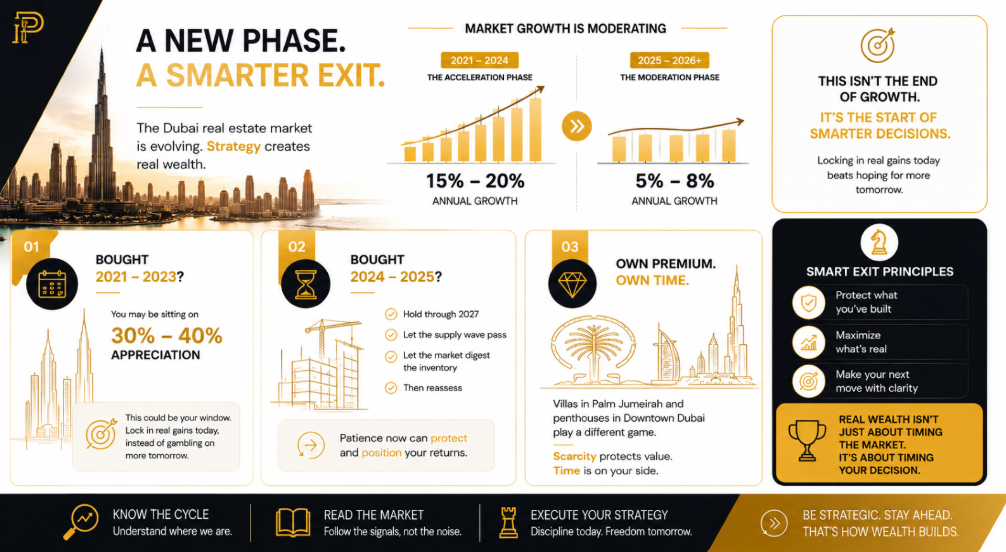
If you bought it in 2024 or 2025, holding through 2027 probably makes more sense. Let the supply wave pass. Let the market digest inventory. Then reassess.
And if you’re sitting on a villa in Palm Jumeirah or a penthouse in Downtown Dubai, you have more time. Premium properties in genuinely scarce locations don’t follow the same rules as mid-market apartments in high supply zones.
Putting It All Together
Success in Dubai property is not about gut feelings. It is about having a plan before you even sign the initial papers. The investors who actually make money know their costs down to the last dirham. They watch market signals and keep their documents ready months in advance.
While Dubai has amazing tax perks, those gains are only yours if you can actually capture them. Do not rely on a hot market. You need a plan long before you sign the papers. Stick to your strategy and know the right moment to walk away with your money. Real profit happens when you figure out how to get out before you ever decide to get in.