
Villas vs. Penthouses vs. Waterfront Apartments: Which Dubai Asset Class Fits Elite Investors Best?

Introduction
Most Dubai property ROI numbers are misleading. Often, this is on purpose. I’ve spent years analyzing real estate markets around the world. I advise wealthy individuals on tax and investment planning. One pattern keeps showing up in Dubai: the “8% Yield” trap. Marketing brochures and social media ads show high gross returns. They promise easy passive income. But these figures are just the start of a bigger story. If you approach property like you would a business investment, you need more detail. The problem is simple. There’s no transparency about the “leakage” between gross rental income and actual profit. Investors look at gross rental yields alone. These show annual rent as a percentage of purchase price. But they ignore many costs that eat into profits. Service charges, maintenance reserves, vacancy periods, and exit costs rarely appear in the pitch.
What is Dubai Property ROI?
Return on Investment (ROI) is more than rent divided by price. When we talk about dubai property roi, we look at how well your money is working. ROI measures the return on your investment compared to its cost. Property ROI is not like a bank deposit. Bank returns are fixed and predictable. Property ROI changes. Market cycles affect it. Tenant behavior affects it. The condition of the property affects it. You need to know the difference between dubai real estate investment return and rental yield. Rental yield is a snapshot. It shows income right now compared to property value. ROI is bigger. It looks at the full picture. It includes the time value of money. It includes financing costs. It includes profit from selling. A property with high rental yield but no value growth may give lower total ROI. Compare this to a property with moderate yield that grows in value. The second one often wins.
Gross vs Net Rental Yield in Dubai
This is where most amateur investors fail. In business, we separate revenue from profit. In real estate, this means Gross Yield vs Net Yield. If your dubai rental yield calculator only asks for purchase price and rent, you’re missing the full picture.
Gross Rental Yield (What marketers show)
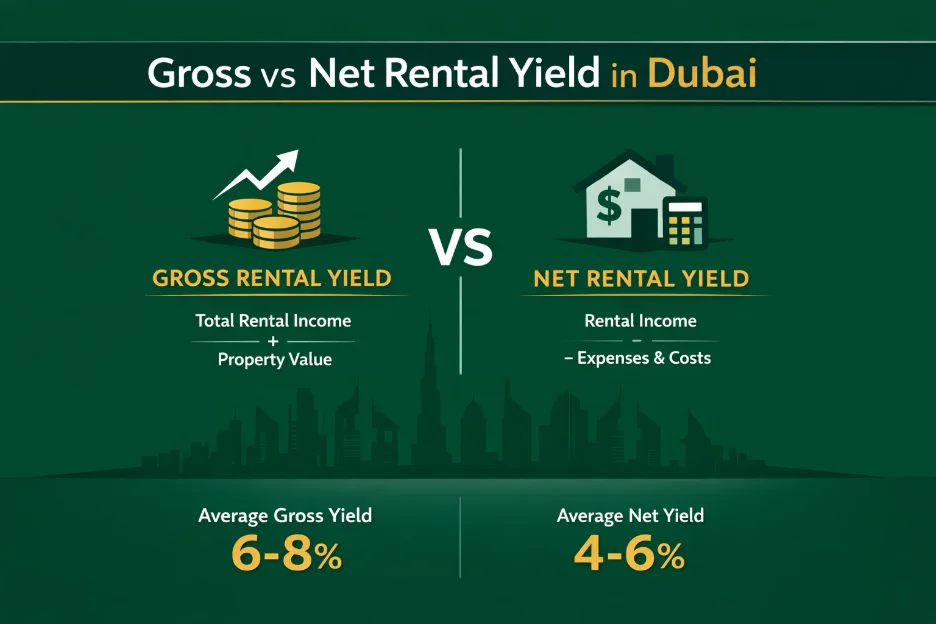
Gross Rental Yield is what you see on every property website. It’s bold. It’s big. The calculation is simple: (Annual Rent / Property Purchase Price) x 100. Say you buy an apartment for AED 1,000,000. It rents for AED 80,000 per year. The gross yield is 8%. This is the “perfect world” version. It assumes the property is never empty. The tenant always pays on time. The building needs no repairs. There are no costs.
Net Rental Yield
Net rental yield in Dubai is what matters for your cash flow. The formula is: (Annual Rent – Annual Expenses) / Total Acquisition Cost. Notice we use “Total Acquisition Cost.” The initial fees (DLD, agency fees) are part of your investment. You must account for deductions. Service charges are fees for building upkeep. Maintenance reserves are funds for unit repairs. Management fees apply if you use an agency. Vacancy allowance covers empty periods. Net ROI is usually 1.5% to 3% lower than gross figures. Take that AED 1,000,000 property. Deduct AED 15,000 in service charges. Deduct AED 4,000 in maintenance. Deduct AED 4,000 in management fees. Your actual net income drops from AED 80,000 to AED 57,000. Your real yield is now 5.7%. That’s very different from 8%.
Full Dubai Property ROI Formula (The “True ROI Model”)
To calculate total Roi Dubai property, you need a lifecycle approach. A professional Dubai property Roi model looks at the entire investment. From first deposit to final sale. The core formula is:
ROI = (Net Rental Income + Capital Appreciation – Total Costs) / Total Investment
Rental Component
The rental component is all net income over the holding period. This number changes. A good model accounts for rental growth. In Dubai, the RERA rental index influences this. Say you hold a property for five years. Project net income for each year. Factor in rent increases. Factor in rising service charges and maintenance costs. This total represents the “dividend” from your property.
Appreciation Component
The appreciation component is simple. It’s the sale price minus the purchase price. This is where most wealth is created in Dubai. But model it carefully. Some areas grow 10%+ in one year. But a safe model should project 3% to 5% annual Dubai property appreciation rate. This is “unrealized” profit until you sell. But it’s vital to total return. Especially with the AED/USD peg giving you currency protection.
Total Investment Cost
The denominator is the total investment cost. This is all capital spent to buy the asset. Many investors only use the purchase price. That’s wrong. In Dubai, the entry price includes the 4% Dubai Land Department fee. It includes the 2% agency commission. It includes various admin and registration fees. If you use a mortgage, add the down payment and bank fees. Divide your total profit (Rental + Appreciation – Costs) by this full investment figure. Now you have true net returns.
What Costs Must You Include in Your Dubai Property ROI?
A good Dubai property roi model depends on good data. To avoid mistakes, analyze all costs. These fall into three groups: upfront, ongoing, and hidden.
Upfront Costs
Buying property in Dubai involves mandatory fees. These impact your initial capital. First is the Dubai Land Department (DLD) fee. It’s 4% of property value. This one-time tax registers the ownership change. Next is the agency fee. It’s typically 2% of the purchase price. VAT of 5% applies. Trustee and registration fees range from AED 2,000 to AED 10,000. This depends on property value and payment type (cash or mortgage). These Dubai property investment cost items add up to 6% to 7% of the purchase price. Factor them into your ROI as part of total investment.
Ongoing Costs
Once you own the property, ongoing costs start. The biggest is the Dubai property service charges. These are calculated per square foot. They vary widely by building and area. A luxury tower in Downtown Dubai might charge AED 40 per sq. ft. A townhouse in a suburb might only need AED 5 per sq. ft. These fees cover security, landscaping, and electricity in common areas. You also need the Dubai property management cost if you don’t live nearby or don’t want to handle tenants. Professional management costs 5% to 8% of annual rent. Build in a vacancy assumption of 5% (about 18 days per year). This covers the time between tenants.
Hidden Costs (Rarely Covered)
The most dangerous costs don’t appear on invoices. Furnishing is a major hidden expense. This matters if you target short-term rentals. A high-quality furniture package for a two-bedroom apartment can cost over AED 50,000. Insurance is often overlooked. Building structure is insured via service charges. But landlord’s liability and contents insurance are your responsibility. Utilities matter too. “Cooling” or chiller charges can fall on the landlord. This depends on community rules and rental contract type. Tenant turnover costs are inevitable. Deep cleaning and repainting happen between tenants. Spread these over the holding period. Reddit Insight: “Most people only talk about gross ROI… net return changes a lot. I’ve seen investors lose 20% of their projected income because they didn’t realize the chiller was landlord-paid in their specific building.”
How Do You Calculate Dubai Property ROI Step by Step?
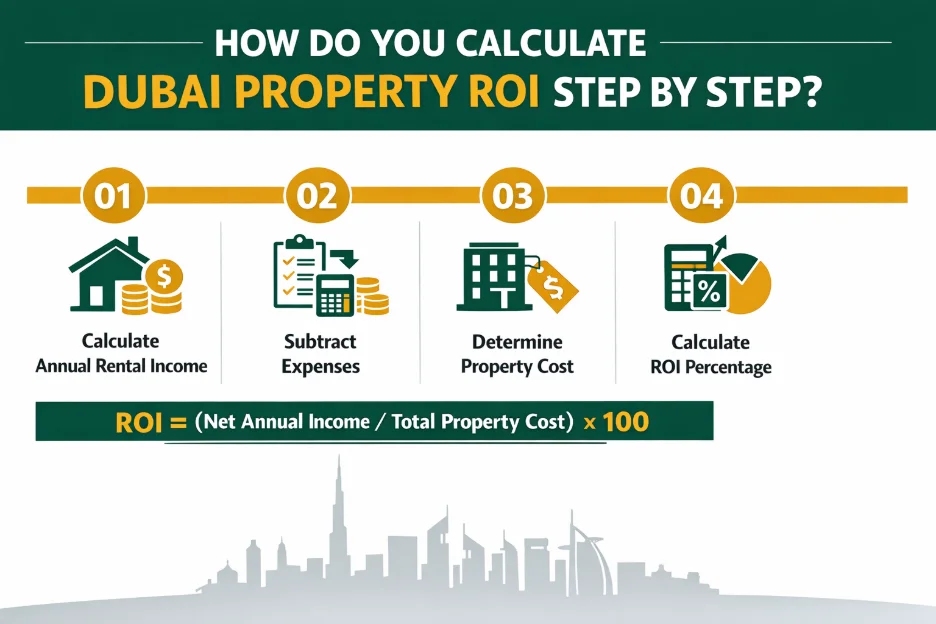
Here’s a five-step method for modeling your returns. This approach ensures you don’t miss any variables. Your final percentage will reflect the Dubai market reality.
Step 1: Calculate Total Investment Cost
Start with the purchase price. Add the 4% DLD fee. Add the 2% agency commission. Add AED 5,000 for admin and trustee fees. Taking a mortgage? Add the 1% bank processing fee. Add the valuation fee. This total is your real cost of entry.
Step 2: Estimate Realistic Rental Income
Don’t use “asking prices” from property portals. Look at actual transaction data instead. Use the Dubai Land Department or REST app. See what properties in that specific building rented for in the last six months. Use this “market realistic” figure as your top-line revenue.
Step 3: Deduct All Expenses
Subtract annual service charges. Base this on the unit’s square footage. Deduct the management fee (if you use one). Deduct a 1% maintenance reserve. Deduct 5% for vacancy.
The result is your Net Annual Rental Income.
Step 4: Add Appreciation
For a safe model, assume 3% annual appreciation over your holding period. Say it’s 5 years. Calculate the projected sale price at year five.
Step 5: Calculate Final ROI
Add your five years of Net Rental Income to your projected capital gain. Subtract your estimated exit costs (selling commission). Divide this final profit by your Total Investment Cost from Step 1.
This gives you your total roi Dubai property.
Dubai Property ROI Example (Real Case Study)
Let’s look at a real case. A client bought a property in Jumeirah Village Circle (JVC) through PFOC Properties. This shows how numbers change with professional modeling.
The Solution:
The client wanted a high-end studio in a luxury tower. After a net ROI analysis, we suggested something different. A well-maintained one-bedroom unit in a mid-range building. Lower service charges. The goal was to maximize cash flow while getting steady appreciation.
- Purchase Price: AED 900,000
- Total Investment (With Fees): AED 963,000
- Annual Rent: AED 75,000
- Service Charges (AED 12/sqft): AED 10,800
- Management & Maintenance (8%): AED 6,000
- Net Annual Rent: AED 58,200
- Net Yield: 6.04%
After 4 years, the property sold for AED 1,080,000. That’s 20% total appreciation.
- Total Net Rent (4 years): AED 232,800
- Capital Gain: AED 180,000
- Exit Costs (2.5%): AED 27,000
- Total Profit: AED 385,800
- Total ROI (4 Years): 40% (or 10% per year)
“We were looking for the flashiest building at first. But the ROI model showed us service charges would kill our returns. PFOC guided us to an asset that was boring on paper but great for our bank account. The data-driven approach changed how we see Dubai real estate.” — M. Bashir, International Investor.
What’s the Difference Between Off-Plan and Ready Property ROI?
The choice between Dubai off plan roi and ready property roi Dubai is important. Each path has different risks and rewards. They appeal to different goals. For a comprehensive breakdown of buying off-plan property in Dubai, see our detailed guide.
Off-Plan ROI
Off-plan property means units still under construction. This is mainly a play for capital appreciation.
Pros: Lower entry price. Attractive payment plans. You can use your capital without a traditional mortgage. You buy at today’s prices for future delivery. You “lock in” current rates.
Cons: No rental income during construction. Risk of project delays. ROI is back-weighted. The bulk of profit comes at completion and resale.
Ready Property ROI
Ready properties give you immediate rental income. Monthly checks start right away. This is the best route for investors who want a “yield-first” strategy. Immediate cash flow helps offset mortgage payments. You get tangible returns from day one. The downside? The entry price is usually higher. Potential for big capital appreciation is often lower. The “developer’s margin” is already realized. But ready properties have lower risk. The physical asset is real. Its rental potential is proven.
Comparison Table
| Feature | Off-Plan Property | Ready Property |
|---|---|---|
| ROI Timing | Long-term (After completion) | Immediate (Monthly) |
| Appreciation Upside | High (Developer growth) | Moderate (Market growth) |
| Risk Profile | Construction & Delay Risk | Market Volatility Risk |
| Cash Flow | Negative during construction | Positive from day one |
What Is the ROI Timeline for Dubai Property?
A professional Dubai property Roi timeline is not a straight line. It’s a curve. You need to know when you’ll reach your Dubai property breakeven point. This helps you manage cash.
Year 1 (Negative ROI)
Here’s a hard truth. In Year 1, most Dubai property investments have negative or neutral ROI. Why? High upfront costs. You pay 7% of the property value in fees on day one. Your rental income for the first year just catches up to those costs. This is normal in real estate. But many brochures don’t mention it.
Year 3–5
Stabilization happens between Year 3 and Year 5. By now, rental income has recovered the initial costs. Capital appreciation has started to compound. This is when “cash-on-cash” returns become meaningful. In a healthy market, net rental income acts as a safety net. Even if the market stays flat, you’re still profiting.
Year 7–10
This is when “True ROI” is realized. Over 7 to 10 years, rental growth and long-term appreciation become the main factors. Property cycles in Dubai last about 7 to 8 years. By holding through a full cycle, you minimize risk. You won’t be forced to sell during a downturn. You maximize potential for a high-value exit.
What Are the Exit Costs When Selling Dubai Property?
The final chapter of your ROI story happens when you sell. The Dubai property exit cost can reduce your final return by a few percentage points. In Dubai, the standard seller’s agent commission is 2% of the sale price. You also need a No Objection Certificate (NOC) from the developer. This costs AED 500 to AED 5,000. Add various admin fees at the trustee office. One big advantage in Dubai is that there is no Dubai property resale tax. In many Western countries, capital gains tax takes 20% to 40% of profit. In Dubai, the gain is yours to keep. But transaction costs still matter. A property sold for AED 1.5M will cost about AED 35,000 to AED 45,000 in fees. Professional modeling subtracts these costs from projected profit long before you sell.
What Are the Risks in Dubai Property Investment?
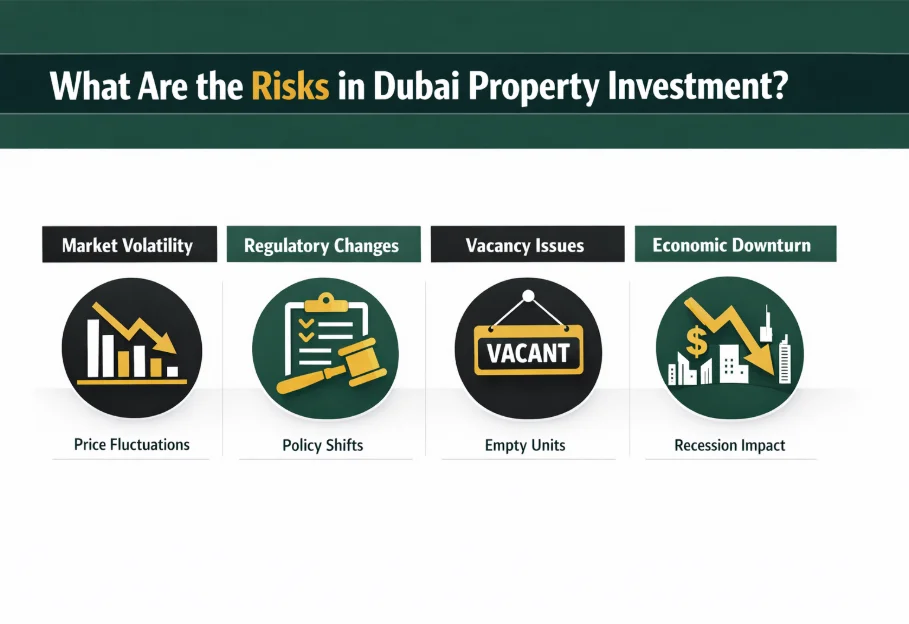
No investment is risk-free. A good guide must address downsides. When looking at Dubai property investment risks, watch several factors. Vacancy risk is the most immediate. If a community gets too many new buildings, finding a tenant at your price may take longer. Service charge inflation is another risk. If the owners’ association or developer raises fees, your net return drops. Market cycles and oversupply are bigger risks. Dubai is a high-growth city. But supply can sometimes exceed demand in certain areas. Monitor the “supply pipeline” for your neighborhood. Global market conditions can affect Dubai liquidity too. Reddit Insight: One experienced investor said, “Rent mostly goes toward EMI… cashflow can be low if you are over-leveraged. The real profit is the capital appreciation at the end, provided you didn’t overpay at the start.”
How Does Dubai Property ROI Compare to Other Investments?
When choosing where to invest, compare Dubai property roi to other options. Dubai vs Pakistan? The main advantage is currency stability. Investing in Dubai means earning in a currency pegged to the USD. This protects against PKR devaluation. For more insights, see our guide on why Dubai is the best property investment destination for Pakistanis.
Compared to bank Fixed Deposits, property offers leverage. A bank may give you 5% on your cash. But property lets you control a much larger asset with the same money. This amplifies returns through capital growth.
What Should Pakistani Investors Know About Dubai Property ROI?
For Pakistani investors, Dubai property roi Pakistan is more than a percentage. It’s a wealth preservation strategy. Pakistanis have been the top investors in Dubai real estate for decades.
Can Pakistanis invest? Yes. Buying Dubai property from Pakistan is straightforward. Non-resident Pakistanis can own freehold property in designated areas. No local partnership needed. If you’re considering the Dubai Golden Visa route through property investment, our comprehensive guide walks you through the entire process.
What about taxes? For Dubai rental income tax in Pakistan, the UAE offers 0% income tax. But Pakistani tax residents must know their FBR reporting obligations. Income is tax-free in Dubai. But it may fall under the global income tax in Pakistan. This depends on current treaties and resident status.
What Common Mistakes Do Dubai Property Investors Make?
- Using gross ROI only: Never base decisions on the “top-line” figure in a brochure.
- Ignoring service charges: These are your biggest recurring expenses. Always verify the rate before signing.
- Overestimating rent: Always use real transaction data. Not optimistic “potential” figures.
- Ignoring vacancy: Buildings are rarely 100% full all year. Always build in a 5% buffer.
- Not including exit costs: Factor in the 2.5% loss at sale to see your true final profit.
How Can PFOC Properties Help You Model Dubai Property ROI?
At PFOC Properties, we believe real estate investment should be science, not gambling. Our approach uses fiscal rigor. We adapt UK tax advisory standards for Dubai’s unique market.
Data-Driven ROI Analysis
We go beyond brochures. We provide real net ROI projections. We use actual historical data for service charges and vacancy rates in specific buildings. The numbers you see on day one are the numbers in your bank account in year five.
Customized ROI Models
No two investors are the same. We build custom models based on your budget, risk profile, and timeline. Whether you want immediate cash flow or long-term capital preservation, our models fit your goals.
End-to-End Investment Support
We handle everything. From finding the property to managing tenants to the final sale. Our goal is to handle the complex parts so you can enjoy passive investment. Explore our complete portfolio of Dubai properties to find your ideal investment.
Special Support for Pakistani Investors
We have deep experience helping Pakistani investors. Legal guidance. Remote buying help. Currency advisory. We ensure your investment is compliant, secure, and optimized for Pakistan’s fiscal landscape. Learn more about our team and expertise.
FAQ’s:
What inputs are required to model true net ROI for a Dubai property?
To build a good ROI model, you need more than purchase price and expected rent. You need the total acquisition cost (purchase price + 4% DLD fee + 2% agency commission + trustee fees). You also need the property’s exact square footage. This calculates service charges. You need the building’s service charge rate per square foot. Get realistic rental data from recent transactions in that building.
What is the formula for total ROI on a Dubai property investment?
The formula for Total ROI over a holding period is: [(Total Net Rental Income over the period + Capital Appreciation) – Total Acquisition & Exit Costs] divided by Total Initial Investment. Unlike simple rental yield, this metric looks at the “lifecycle” of the investment. It includes rent over time. It includes capital gain from price appreciation. It includes all costs from purchase to sale.
How do I calculate net rental yield for Dubai property?
Net rental yield is: (Annual Rental Income – Annual Operating Expenses) / Total Acquisition Cost. Operating expenses must include service charges. Include property management fees (if you use an agency). Include insurance. Include a sinking fund for repairs. Also, apply a 5% vacancy factor. This covers the period between tenants when the property earns nothing.
How should I model property price appreciation in Dubai?
Modeling appreciation needs historical data and future infrastructure analysis. The Dubai market has seen periods of 20%+ growth. But a safe model should use a 3% to 4% annual appreciation rate. This accounts for long-term trends, not short-term excitement. Factor in upcoming infrastructure projects. New metro lines. Expo legacy developments. But stay careful. Always test your model with a “flat market” scenario. Use 0% appreciation. Make sure rental income alone justifies the investment.
How do mortgage and financing costs affect property ROI?
Financing introduces “leverage.” This can amplify your ROI. Or amplify your losses. When modeling, subtract annual interest payments from rental income. Example: You put down 20% (AED 200,000) on a AED 1,000,000 property. You finance the rest at 5% interest. Your annual interest cost is about AED 40,000. This cuts your net rental income significantly. But if the property appreciates 5% (AED 50,000), your return on actual cash invested (AED 200,000) is much higher than if you paid cash. Leverage works both ways. Model carefully.
What exit costs should I include when selling Dubai property?
Many investors forget that profit is only real after exit costs. In Dubai, the main exit cost is the seller’s agent commission. This is standardly 2% of the sale price (plus VAT). You also need a No Objection Certificate (NOC) from the developer. This costs AED 500 to AED 5,000. It depends on the project. Add trustee office fees for sale registration.
How do service charges affect net rental returns?
Service charges are the biggest variable in Dubai property ROI. These fees go to the building’s Owners Association. They cover maintenance of common areas, gyms, pools, and security. They’re charged per square foot of “Total Area” (including balconies). A 700 sq. ft. apartment in a building charging AED 20/sq. ft. costs you AED 14,000 per year. This can easily take 15% to 20% of your rental income. Always verify the current service charge rate before buying. Buildings with many amenities have higher charges. This directly cuts your net yield.
How is rental income and capital gains taxed in Pakistan for Dubai property?
For Pakistani residents, the UAE offers a 0% tax environment. No tax on rental income. No tax on capital gains. There’s no withholding tax. No income tax on rent. No capital gains tax on sale. But Pakistani tax residents must consider FBR obligations in Pakistan. Under Pakistani tax law, residents are taxed on worldwide income. This means Dubai rental income may need to be declared on your Pakistani tax return.
Which ROI metrics should I use (IRR, CAGR, cash-on-cash)?
For a simple yearly view, use “Net Rental Yield.” For understanding how your initial cash is performing, use “Cash-on-Cash Return.” This is the Annual Net Cash Flow divided by the actual cash you paid upfront. Want to account for the time value of money across the full investment? Use Internal Rate of Return (IRR). This is the most sophisticated metric. It factors in the timing of all cash flows.
Conclusion: Mastering the 2026 ROI Landscape
The Dubai property market in 2026 requires a shift. Move from speculation toward a data-driven strategy. As we’ve shown in this guide, true asset performance is never on a marketing flyer. It’s revealed through a rigorous Dubai property roi model that accounts for every reality. Dubai’s population now exceeds 4 million residents. Over 150,000 new units will enter the market between 2025 and 2027. The “wait and see” approach no longer works for high-net-worth individuals. Success in this maturing market belongs to those who prioritize Dubai property net returns over gross yields. Ready to build a professional ROI model for your Dubai investment? Contact PFOC Properties today for a complimentary property analysis and personalized investment strategy tailored to your financial goals.